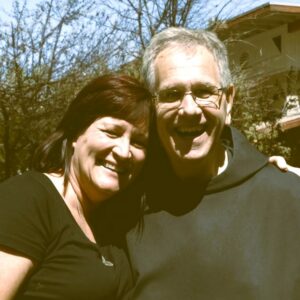
Recently my Spiritual Director passed away. He was a wonderful example of Jesus with skin on. He was a lover of the many people who visited the abbey where he had lived for over 50 years. He was an incredible mentor to me and loved me through a multitude of difficult situations. I miss him deeply. As I reflect on his death I am saddened by three things; the loss of this gentle man to the many who sought his help, my own loss of a wise and compassionate Spiritual Guide, and most importantly, I don’t want his wisdom to die with him. With that end in mind, I have set my heart to do my best to share the Wisdom of my friend Fr. Francis.
2015 left me in mourning. My husband of 34 years had lost a five-year battle with alcoholism. Found by a stranger, alone, and dead. The struggle was over. During those years my life had been hijacked by his destructive behavior. When I finally stepped aside to let him find his way, my life then was hijacked with guilt and shame. I had tried to stay strong, to remain at his side, as a dutiful Christian wife, while he struggled. However, the more I tried to help him, the deeper and deeper I sank into depression, confusion, and self-loathing. Surely with love I could find an answer to his problem. It became increasingly obvious that my love could not save him, and my helping was not – helping. When he died this illusion of failed helpfulness led me deeper into depression. Only now, there was nothing that I or anyone else could do to help. He was done. It was over. He was dead.
A small sense of relief led me down a path of more guilt and shame, it was almost too much to bear. I’m thankful my faith tradition offered me an opportunity to release the weight of these obsessive thoughts in the Sacrament of Confession (or Penance as it’s officially called).
My confessor, Fr. Francis, is two hours away. Two hours that provided me the opportunity to examine my part in my husband’s descent into alcoholism and death. Alone in the car I could formulate an extensive list as to why I was responsible for his death. The conflict between being a “good Christian wife” and trying to live a life with boundaries caused me so much agony.
“You should leave him.” Came as the battle cry from many, several among the clergy.
“Okay, yes, I should leave him.” But the real part, the part of their battle cry that caused me the deepest pain was the question,
“Where does it say in the Gospels that I can abandon this very sick man?” The battle cry was quieted, they could offer no answer.
As I arrived my confessor greeted me with his usual hug. A warm, comforting embrace that gave me the feeling of protection from a source outside myself.
“I want you to hear my confession.” I quietly whispered in the safety of his embrace.
“Okay.” Came the gentle reply whispered almost as quietly as my request.
Silently we walked to the abbey chapel and made ourselves comfortable in the wooded confessional room. Armed with an extensive list of my wrongdoings (formulated in the 2-hour car ride) I began, “Forgive me Father …” He interrupted me. “Lisa,” taking my hands into his he said, “Simply say you’re sorry for whatever part was yours.” Stunned by his kindness I said, “Lord, I am sorry for whatever part was mine.” He continued gently with the grace-filled prayers prayed after confession, and we were done. Grace and forgiveness for “whatever part was mine.” I couldn’t believe it was that easy.
It is a cunning lie that those who love an addict feel that – somehow – they’re to blame. That somehow, they were not smart enough, not quick enough, not crafty enough to solve the problem for the one they love. A wicked and powerful lie. Yet, in his compassionate wisdom Fr. Francis officially, lovingly, and somewhat unconventionally released me from the grips of this lie. He could have easily insisted I recount the sorted details of this painful season, sending me back to hating myself for not rescuing the one I loved. I had spent years examining my actions and inactions, constantly beating myself up. With love and gentleness and without more self-flogging, I was released from guilt and shame. Fr. Francis was truly the physical presence of a loving God to me during a time of little comfort and less love. A gift.
Have you ever experienced a gift like this? Pure grace and pure love! Sometimes we have to be in a really dark space before any light pours in! What could you let go of if you were in that confessional with Fr. Francis. What could his gentle loving kindness help you release? Can you simply ask God to release you from “whatever part was yours?” Can you believe it is that easy? Can you accept this kind of unconditional love and forgiveness? Fr. Francis truly showed me God’s love at that moment, and I endeavor each day to release the chaos of guilt and shame that tears down my heart. Love builds up, it never tears down. Thank you, dear Francis, for building me up with your tangible expression of God’s love.
 I don’t like categorizing a year as being a “good” or a “bad” or recounting “who we lost this year.”

 I have had an odd relationship with the idea of thankfulness. My earliest memories of being thankful came wrapped up in the torturous duty of writing thank-you notes. I know my young mother was trying to instill within me a sense of being thankful. But the task was always tinged with duty and properness. I recall sharply her edits of my thank-you notes, “Write it again.”

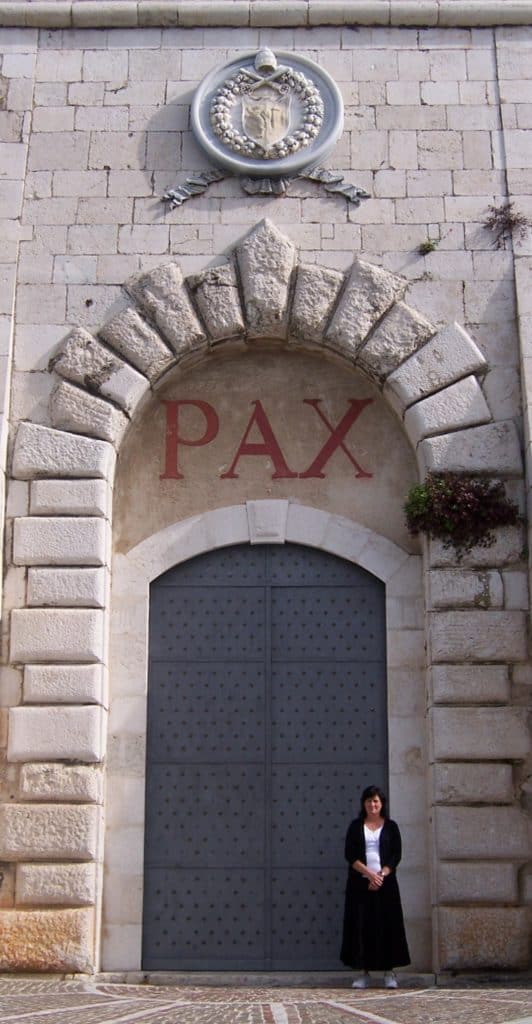 That’s a picture of me in front of the ancient arch way of his Abbey in Montecassino, Italy. I visited in 2006. It was amazing. Their website is amazing too:
  these practices, so this summer I’m gathering a group to practice listening to God. We’ll meet in north Orange County on Thursdays from 7 – 9pm.