Author: Lisa Marion

What is Your Legacy?

This idea of LEGACY, keeps circling back to me. It was on my mind during the 3-day weekend celebrating the life of Martin Luther King, Jr. and it kept bumping around in my thoughts during the recent Presidential Inauguration and the Women’s March the day after.

Have you ever thought of the legacy you’re leaving behind? I don’t think many of us do. I wonder if great political leaders think on this? Did Martin Luther King, Jr. realize the legacy he left us? I suppose he thought his dream of racial equality would endure, but I wonder what he would think about the redemption of his suffering almost 50 years after his death?

Years ago I had the opportunity to visit his burial site. A stately marble coffin sits dramatically amid a calm reflection pond at his Center for Nonviolent Social Change in Atlanta, Georgia. His headstone marked with: Free at last, Free at last, Thank God Almighty, I’m Free at Last. Powerful words he used in one of his famous speeches, but many people do not know that those words are lyrics from an old Negro Spiritual. I think much of the world has forgotten he was a Christian Pastor and his civil rights movement was motivated by Christian love, all part of his legacy to us.

His story is marked with a strong commitment to non-violence amid horribly violent acts, that ultimately resulted in his murder. As I reflect on his story, some parts are too difficult to imagine. Those close to him felt he knew he wouldn’t live long. I cannot imagine the inner turmoil he must have struggled with.

We all have difficult parts of our story that can inspire others, perhaps not as dramatic as Dr. King’s, but still important. If our stories aren’t shared, the lessons aren’t shared. We must be able to see how our stories plays-out in the larger story of “us.” A big part of this, is knowing yourself, knowing the role you’re playing; the good, the bad and the ugly. What is the story of your life? What is the legacy you’re leaving behind? What struggles have you overcome? What commitments have you made? Have you fought for what is important to you?

If this sparks your imagination, I want to suggest a few books that I have found helpful in my own journey to knowing myself better and telling my story.

The first book, written by Vinita Hampton Wright is The Soul Tells a Story: Engaging Creativity with Spirituality in the Writing Life Designed as a type of creative devotional for writers, the reader is taken to new places of self-discovery and ultimately, God-discovery. Each chapter concludes with “Exercises for a Writer’s Formation.” I found it challenging and well written.

The other book was assigned to me in grad school. Although required reading, I found it helpful as I unraveled some of my childhood assumptions about myself. I suppose that was the professor’s goal. Reclaiming Your Story: Family History and Spiritual Growth by Merle L. Jordan, examines and then skillfully breaks down the tension between the authority of one’s family structure, and Divine authority. There are thoughts for contemplation included in each section. The final chapter entitled, “Renewing Your Spirit by Reauthoring your Childhood Story” maps out an exhaustive list of quasi-therapeutic writing projects.

Don’t be afraid to tell your story. Our stories are the seeds of inspiration for others. I’d love to hear your thoughts and encourage you to tell your story, your legacy. Leave a comment below, or message me on Facebook.

PAX

~ lisa


Here is a collection of Dr. King’s thoughts, in his own words, a beautiful little gem that I’ve had on my bookshelf for over 35 years: The Words of Martin Luther King, Jr.: Second Edition by King, Martin Luther, III, King, Coretta Scott 

#CleanOffYourDeskDay

cleanoffyourdeskdayObserved the second Monday of January, National Clean Off Your Desk Day gives you an opportunity to begin the new year with a clean and organized workspace. Promoters insist that “Having your workspace uncluttered, organized, refreshed and clean will help you work more efficiently and give you a sense of serenity.”

My desk is always a mess, yet, I know where things are. I have piles for different types of work that is grouped by theme; a pile for bills, a pile for taxes, a pile for things to read … so that when I have to deal with an issue, I know which pile to go to. A whole day to clean things off, well … that takes time, and besides I’m proud to boast I have a high “clutter tolerance.”

Although I CAN work this way, I know it isn’t best. When I do take the time to organize my desk, pick up the trash, and move the piles into folders or file drawers it does make things easier. I hate to admit it; but the clutter does impair my productivity.

My soul is the same way; over time, my inner space gets cluttered with unfinished thoughts and situations. Emotional piles of stuff laying all around. I can push through, insisting I’m fine, but this never leads to serenity. No, just like I must take time to clean off my workspace, I need to take time clean up my inner space, to think on things, journal about my feelings, and find some closure or direction.

I have discovered that I don’t have a high “emotional clutter tolerance.” I need regular times of retreat to sort through my internal piles of stuff. In the solitude, I am able to move forward through my inner untidiness.

I use a visual exercise for this type of uncluttering. It’s called “Reflection – Organizing the Past Year” Designed for a retreat, I’ve modified it for use during a simple one-hour time of reflection. As you work the exercise you will create a tangible representation of the past year, getting to organize the piles of your own emotional stuff. I’d love to share it with you. Subscribe to my site by clicking here, and I’ll send it over.

So, my friends, here’s to a new year, full of fresh beginnings. Take the time not only to clean up your workspace but more importantly, make time to uncluttered your heart too.

PAX

~ lisa

Resolve, Yes. But Something More is Needed!

Ok, it’s that time. Time for looking back and figuring out how we’re going to do this thing called life – better. We’ve collectively said we’ll join a gym, eat differently, or give up a bad habit, but we all know how that’s going to end. Experts say that most New Year’s Resolutions will be abandoned by the 17th of January, “Ditch Your New Year’s Resolution Day.”   There’s even a hashtag:  #ditchyournewyearsresolutionday

I don’t buy into the argument that you shouldn’t make a New Year’s Resolution simply because you’ll most likely fail. I think resolutions are good, and self-reflection is a key element of Spiritual Growth. The impulse to make a resolution is right, but something more is needed; a way to make the resolution work! I believe it is a matter of moving those resolutions from the subjective “desire realm” into the objective “reality realm.”

I have adopted living by a Rule of Life as a means to integrate my desires into reality. The idea of a Rule of Life is a very old Christian tradition. The word RULE originally comes from the monastic tradition, and is used to outline a code of life that members of a community agree to follow. Comparing the two words might shed some light on why I think a Rule of Life is helpful.

Resolution, n.
A trait of being resolute. Finding a solution to a problem. A decision to do something or to behave in a certain manner. (Sound familiar?)

Rule, n. 
A principle or condition that customarily governs behavior. Something regarded as a normative example. Prescribed guide for conduct or action.

A rule makes something customary, a resolution is simply making a decision.

Let me give you an example so you can see how I put the principle of Rule of Life into play with something very ordinary. I have always loved my cell phones, and use them a lot. I also drop my cell phones, a lot. About a year ago, I finally purchased one of the biggest, fastest, and most powerful cell phones they make … and yes, I dropped it. I was walking to the car hurriedly and I dropped it, and then I kicked it under the car. I was so furious at myself. It cost a ton of money to fix, and it was very aggravating.

I thought “I must find a way to prevent this from ever happening again.” But, just having the desire NOT to drop my cell phone wasn’t enough. So, I made a rule for myself.

NEVER carry your cell phone in your hand.

It didn’t take me long to keep the rule, because it became part of how I operate. It’s been a long time since I’ve dropped my cell phone, because I never carry it anymore. It is either in my purse or a pocket or tucked away on my person somewhere.

throughwindowHaving a Rule objectifies things. You follow the Rule whether you feel like it or not. There is a Rule that I must stop at all red lights, so I do. There is a Rule that I must wait in line at the grocery store, so I do. I have made a Rule that I don’t carry my cell phone, so I don’t.

We can take the subjective desires behind our New Year’s Resolutions and incorporate them, objectively, into our Rule of Life. I’ve desired more peace in my life, so one thing I’m adding to my Rule of Life this year is to observe a 24-hour period of silence on the first Friday of each month.

Creating a rule isn’t difficult, there are many resources.  I have led many people through the process. Through the years, I have designed a simple worksheet that walks you through the steps. Email me lisa [at] dailypax.com.

Here’s to a new year, full of new rules to follow – objectify your desires, and you’ll have better results bringing your resolutions to life.

pax,

~ lisa


Bareroot Faith

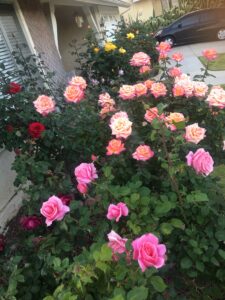
It’s that time again, time to prune my roses and select new bushes from the myriad of bareroot roses available this time of year. I’ve decided to add the new John-Paul II rose. A fragrant pure white rose with 5” blossoms. Bareroot roses are usually sold in January and February, which is their dormant season. They come packaged in plastic bags with their bare roots packed in sawdust. A healthy plant will have 3 or 4 bare canes protruding out of the bag. These ugly barren canes will eventually blossom and become a beautiful rosebush.

I remember when we first started our rose garden. We had lived in our home about 2 years and decided to tear out all the existing shrubs in the front yard and plant 12 bareroot roses. The whole family worked several days: digging holes, measuring fertilizer, opening bags, discarding sawdust and arranging the bare stocks. We attracted the attention of a neighbor boy, Chris. He sat and chatted with us each day. He was so curious about what we were doing. As we finished up that last day Chris said, “Can I ask you why you planted all these sticks in your yard?” It never occurred to me that Chris had never seen a bareroot rose being planted. He must have thought that we had lost our minds.

I began to explain how bareroot roses work. Chris’ young face revealed to me that he did not have enough life-experience to believe my “bareroot theory.” I encouraged him to watch the sticks over the next 5 months. I tried to support my “theory” by telling him I had planted sticks before and they do, in fact become roses by spring. As I reflected more on our conversation it struck me that faith is like planting bareroot roses. It is only with the knowledge of who God is and what he can do that we can faithfully carry on, looking for the eventual blossoms – even in the darkest, dormant seasons of our lives.

I remember one such period in my life, I’ve had many. It was early on in our marriage, my husband had an awful accident. The doctors didn’t think he would live, let alone walk or ever work again. During that time I struggled with suicidal thoughts and was prone to panic attacks. We lost everything in a matter of months – everything, our car, or home and our source of income, not to mention the toll it took on my young husband’s health. I took on a second job while he recovered. I rode a bicycle to and from work. Many times shopping at the market and somehow struggling home with milk and bread.

Throughout that year it was the faith of others that got me through. My parents mostly, they kept encouraging me, praying for me. I had never experienced the deep, deep feelings of isolation that engulfed me during those days, I was only 23. I wish I could tell you, I turned to God and I felt his presence along side me … I didn’t. I had no choice but trust those who knew God and knew that he was there – even though everywhere I looked there was little to no evidence of his presence or existence. What I experienced was just a small taste of the isolation that Christ felt in his last moments on the cross. His final words calling out, “My God, My God, why have You forsaken Me?” (Matt 27:46)

I’ve come to understand that faith isn’t a “program” just something to follow to make hardships disappear. No, faith is what keeps me connected to God. But faith, just like everything else that is important to us, takes work. It takes discipline, a commitment to things that will grow our faith. Things like regular prayer and Bible reading, seeking God’s direction in everything, being connected to a church that will keep you accountable, and surrounding yourself with people of faith.

Odd, but at difficult times, it’s my spiritual disciplines that I want to abandon first. The natural thought is “Well, this isn’t working. There’s something more that I should be doing.” But it is during those times that spiritual disciplines are most important. Faith isn’t the end; it is a means to an end. The End is a closer relationship with God. Faith is what allows us rely on him, to get through those dark times – and emerge on the other side stronger and better prepared for the next challenge that life brings. Christ called out to God in those last moments; did God deliver him from the cross? No – God permitted the pain and sorrow because he had something bigger in mind.

Although I never presume to know the mind of God, I have learned that I can trust him, trust that he has something bigger in mind for me. I look back at that dark time in our marriage and I can see that God was at work and present. It gives me assurance and I can rest in the knowledge that he is present, regardless of how things might appear or the isolation that I feel. Just like my rose garden, there may only be sticks this winter, but I know I will have roses in the spring.

Conditional Forgiveness & Unconditional Love

Thinking about these two contrasting ideas today.

God’s forgiveness is conditional. We are only forgiven in as much as we forgive.

However …

God’s love is unconditional. We are loved no matter what. This we take for granted. We shrug off God’s love as if it’s something of a right.

But think about forgiveness – unless we can turn to our friends, family and acquaintances and forgive them – God will not forgive us.

Could it be that love is something we all need, no matter what. But forgiveness is something that can only be experienced as we learn to forgive?

Something to think about.